Hello viol players – in these times of self isolation, I thought it would be a good idea to learn how to refret your viol.
This is the first upload to my new YouTube channel. Enjoy and share!
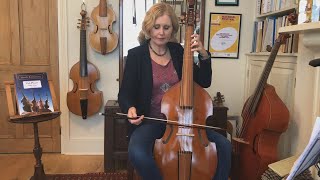
Lower Intermediate Bass Lesson 10: Sight Reading Techniques, Which Position is Best – Half or First?
p32 More Chordal Fingering with 2nd and 1st fingers. Looking at the basis of advanced techniques in the study: More Chordal Fingering – Yipee!
p50 No 36 My Love gave me a Cherry – Looking at key signatures and accidentals to define which position. More crab walking shifts with contracted fingering across two strings starting with pizzicato. Then arco with a reminder to check the position of the thumb.
p52 Mad Tom: Techniques to help sight reading: scan (a quick look!) a piece by looking ahead, spotting accidentals that would necessitate a shift and then deciding which position (half or first) to play in, before you start. Looking at how some phrases are so much easier to play in either first of half position. How the bass player in a consort is responsible for keeping the consort together rhythmically, with good articulation.
p50 No 36 My Love gave me a Cherry – Looking at key signatures and accidentals to define which position. More crab walking shifts with contracted fingering across two strings starting with pizzicato. Then arco with a reminder to check the position of the thumb.
p52 Mad Tom: Techniques to help sight reading: scan (a quick look!) a piece by looking ahead, spotting accidentals that would necessitate a shift and then deciding which position (half or first) to play in, before you start. Looking at how some phrases are so much easier to play in either first of half position. How the bass player in a consort is responsible for keeping the consort together rhythmically, with good articulation.
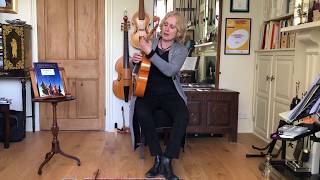
Treble Viol Elementary 1: with Jacqui
Viol Player Book 1
Chapter 1
P24 Up and Down Again
P40 Soldier’s Call
• Looking at good posture, not arching your back, with knees over feet. Holing the viol with the right side tucked in.
• Does a rubber cloth help in the initial stages of learning the viol? The advantages and disadvantages.
• Learning the names of the strings from the middle out, rather than from the bottom string up.
• Left hand position and the relationship of the thumb to the second finger. Keeping the thumb bent out with the point of contact on the side. Transferring weight to each finger and not pressing too hard.
• Placing of the fingers correctly on the frets so each plucked note rings. Impossible to get a good sound with the bow if the finger on the fret is not placed correctly.
• How to play pizzicato.
• Learning in such a way that the left hand can go on autopilot, playing with your eyes closed and visualising the notes.
P40 Soldier’s Call
• Looking at good posture, not arching your back, with knees over feet. Holing the viol with the right side tucked in.
• Does a rubber cloth help in the initial stages of learning the viol? The advantages and disadvantages.
• Learning the names of the strings from the middle out, rather than from the bottom string up.
• Left hand position and the relationship of the thumb to the second finger. Keeping the thumb bent out with the point of contact on the side. Transferring weight to each finger and not pressing too hard.
• Placing of the fingers correctly on the frets so each plucked note rings. Impossible to get a good sound with the bow if the finger on the fret is not placed correctly.
• How to play pizzicato.
• Learning in such a way that the left hand can go on autopilot, playing with your eyes closed and visualising the notes.
Pardessus lesson (part 1): Marais/Villeneuve Echo Fantaisie
In 1759 Jean-Pierre de Villeneuve published transcriptions of approximately 200 pieces selected from Marin Marais' five books of Pièces de Violes, which have been recently published by Alice Brin Renken, available from the Boulder Early Music Shop, USA.
In the later publication of 1762 Villeneuve transcribes the pieces for two and three viols as well as trios by Corelli. It is from this manuscript VM71107, the Fantaisie en Echo can be found, but with the continuo part missing, presumably because Velleneuve thought the duet was complete without it.
In this lesson, Marais' ornaments are introduced with technical advice about how to play them and also in the French style.
At the end of the lesson there is a play along track where you can play the second part with Jacqui.
In the later publication of 1762 Villeneuve transcribes the pieces for two and three viols as well as trios by Corelli. It is from this manuscript VM71107, the Fantaisie en Echo can be found, but with the continuo part missing, presumably because Velleneuve thought the duet was complete without it.
In this lesson, Marais' ornaments are introduced with technical advice about how to play them and also in the French style.
At the end of the lesson there is a play along track where you can play the second part with Jacqui.
Marais/Villeneuve – Fantaisie en Echo: Lesson Part 2 & Play Along – Without Ornaments
In Part 2 of this lesson, we look at this piece without ornamentation.
This is for 4 reasons:
1. to make listening to the other part easier
2. to make phrasing easier to understand
3. to make it easier to place the ornaments
4. how to be on the right place on the bow
(The bar numbers I refer to in the video are for the top part.)
At the end of the lesson there is an un-ornamentated (mostly!) play along track to play the second part with Jacqui.
This is for 4 reasons:
1. to make listening to the other part easier
2. to make phrasing easier to understand
3. to make it easier to place the ornaments
4. how to be on the right place on the bow
(The bar numbers I refer to in the video are for the top part.)
At the end of the lesson there is an un-ornamentated (mostly!) play along track to play the second part with Jacqui.
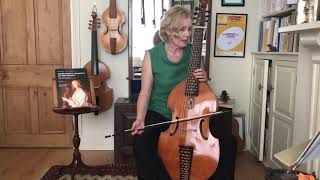
Bass Advanced Lesson 1: Allemande, Jean-Baptiste Antoine Forqueray, Pièce à Trois Violes
Lower Intermediate Bass Lesson 10: Sight Reading Techniques, Which Position is Best – Half or First?
Treble Viol Elementary 1: with Jacqui

Pardessus lesson (part 1): Marais/Villeneuve Echo Fantaisie

Marais/Villeneuve – Fantaisie en Echo: Lesson Part 2 & Play Along – Without Ornaments
Bass Advanced Lesson 1: Allemande, Jean-Baptiste Antoine Forqueray, Pièce à Trois Violes
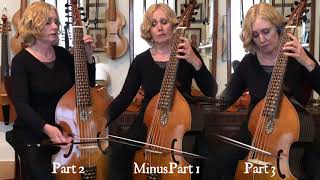
Play Along Minus Part 1 Allemande: Jean-Baptiste Antoine Forqueray, Pièce à Trois Violes
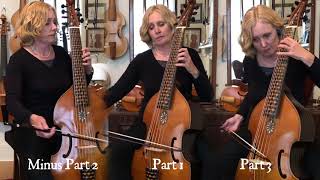
Minus part 2: Play along Jean-Baptiste Forqueray Allemande, Pièce à Trois Violes
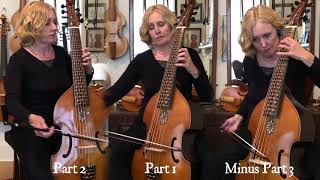
Minus part 3: Play along Jean-Baptiste Antoine Forqueray Allemande, Pièce à Trois Violes